Tile Joint Spacing & Tile Spacers Guide | TILER Pro Tips
- Share
- Issue Time
- Jul 3,2026
Summary
Tile joint spacing guide: spacer types, coverage calculator, and pro tips for professional tile installation with TILER tools.
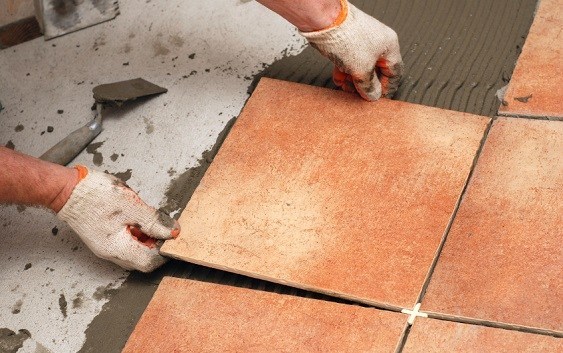
Part One: Tile Joint Spacing Design — Why It Matters
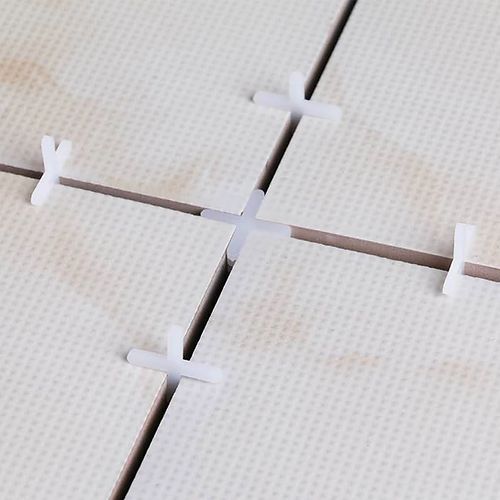
Four Critical Functions of Tile Joint Spacing
① Thermal Expansion
All materials expand and contract with temperature changes. Without adequate spacing, tiles will crack, lift, or "tent" — especially with underfloor heating or outdoor installations.
② Dimensional Variation
No tile is perfectly identical. Even rectified tiles have manufacturing tolerances. Proper spacing absorbs small size differences so they're not visually noticeable.
③ Structural Integrity
Grout fills the joints, locking tiles together as a unified surface. Joint width directly determines how well grout performs both structurally and as a waterproof barrier.
④ Visual Rhythm
Narrow joints create a seamless, monolithic look. Wider joints create a grid pattern that emphasizes each individual tile — choose based on your design intent.
Key Factors That Determine Joint Width
1. Tile Type and Rectification
| Tile Type | Rectification | Min. Joint | Notes |
|---|---|---|---|
| Rectified porcelain | Precision ±0.5mm | 1–2mm | Near-seamless look achievable |
| Standard ceramic | Not rectified | 2–3mm | Needs wider joint for size variation |
| Natural stone (marble) | Calibrated | 3mm | Prevents lippage from natural variation |
| Natural stone (slate) | Uncalibrated | 3–5mm | Must account for significant size differences |
| Glass / mosaic | Precision | 2mm | Standard for small format tiles |
2. Tile Size
Rule of Thumb
Larger tiles need wider joints — not just for looks, but because they're more susceptible to substrate movement.
- Small (<300mm): 2–3mm
- Medium (300–600mm): 3mm
- Large-format (600–900mm+): 3–5mm
- Extra-large (900mm+): 3–5mm or more
Why Larger = Wider
Bigger tiles have less flexibility to absorb substrate stress. Wider joints give the tiled surface room to move without cracking.
3. Installation Environment
| Environment | Key Concern | Recommended Joint |
|---|---|---|
| Interior wall | Aesthetics | 1.5–3mm |
| Interior floor | Foot traffic + slight movement | 3mm |
| Underfloor heating | Thermal expansion | 3mm minimum |
| Outdoor / exterior | Weather, freeze-thaw cycles | 5–10mm |
| Shower floor | Waterproofing, drainage | 3–4mm |
| Swimming pool | Water pressure, expansion | 5–8mm |
| Commercial kitchen | Heavy traffic, cleaning | 3–5mm |
4. Grout Type
Unsanded Grout
Joints up to 3mm
Smaller joints don't need sand for strength; unsanded grout flows into narrow gaps cleanly.
Sanded Grout
Joints 3–6mm
Sand prevents cracking in wider joints. Standard for most floor installations.
Epoxy Grout
Joints 1–10mm
Flexible, waterproof, and stain-resistant. Works across the full width range.
Industry Standards & Best Practices
Tile Council of North America (TCNA)
TCNA Handbook for Ceramic Tile Installation
- Floor tiles over radiant heating: min 3mm
- Exterior installations: min 3mm
- Shower floors: min 3–4mm
- GPP panels >900mm: min 3mm
European Standard EN 14411
Ceramic Tiles — Definitions, Classification, Characteristics
Joint width should be at least 3× the maximum allowable dimensional tolerance of the tile.
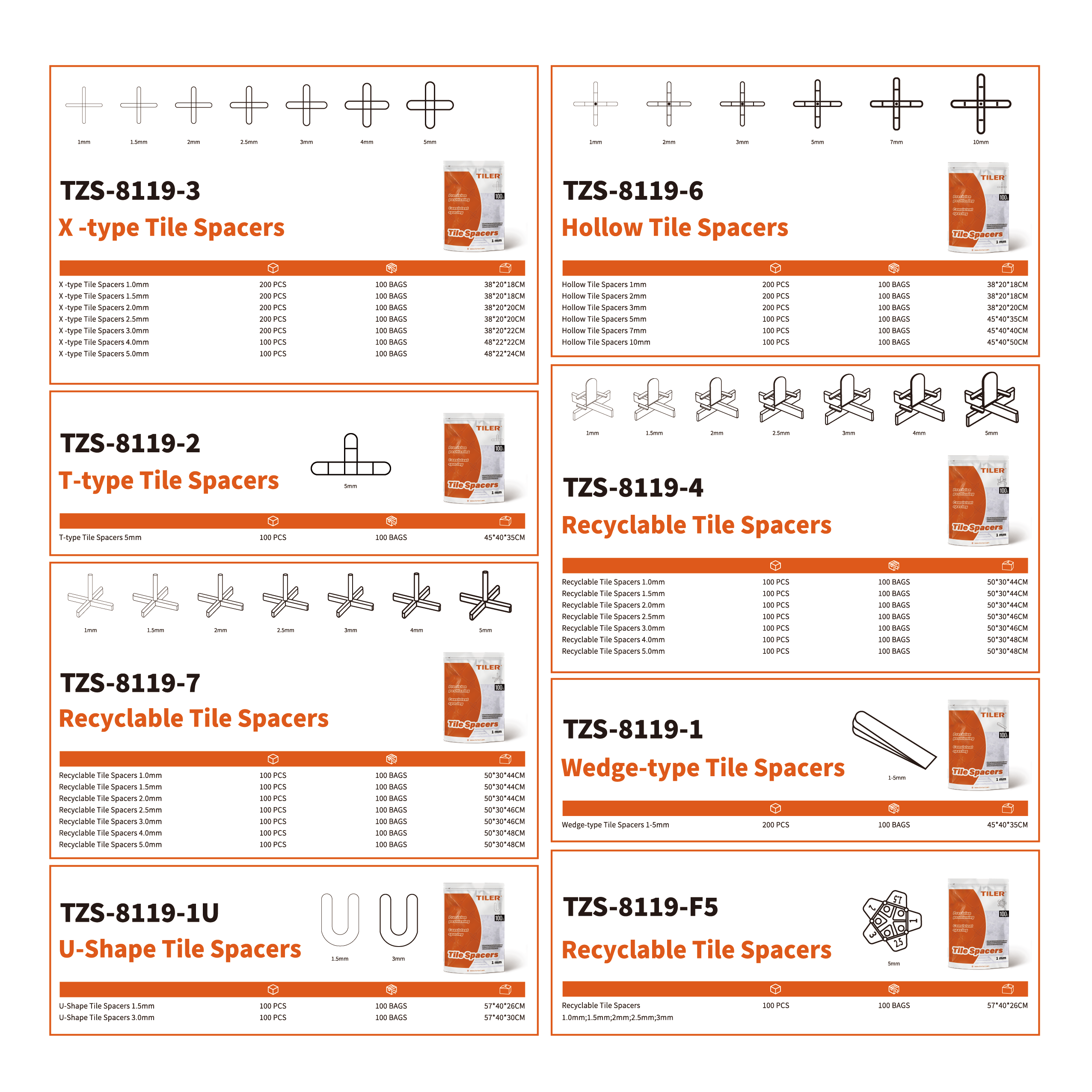
Part Two: TILER Tile Spacer Product Range
Part Three: Spacer Quantity Calculation — Coverage Algorithm
How to Use This Table
X-type spacers — Cross Bond / Stack Bond
Used when tiles are laid in a grid pattern — all tile corners meet at intersection points. One X-type spacer placed at each corner intersection.
Formula: Tiles/m² × 1 spacer/tile = Spacers/m²
T-type spacers — Offset / Brick Bond
Used when tiles are laid in a staggered pattern — each tile bridges two rows. Two T-type spacers required per tile (one at each end of the offset joint).
Formula: Tiles/m² × 2 spacers/tile = Spacers/m²
Universal formula:
Pieces required = Coverage rate (pcs/m²) × Installation area (m²)
Square Tile Format — Coverage Rates
| Tile Size (cm) | Tile Size (mm) | X-type Spacers (pcs/m²) | T-type Spacers (pcs/m²) |
|---|---|---|---|
| 10 × 10 | 100 × 100 | 100 | 200 |
| 15 × 15 | 150 × 150 | 49 | 91 |
| 20 × 20 | 200 × 200 | 25 | 50 |
| 30 × 30 | 300 × 300 | 16 | 25 |
| 33 × 33 | 330 × 330 | 13 | 21 |
| 40 × 40 | 400 × 400 | 9 | 15 |
| 45 × 45 | 450 × 450 | 9 | 13 |
| 50 × 50 | 500 × 500 | 4 | 6 |
| 60 × 60 | 600 × 600 | 4 | 4 |
| 75 × 75 | 750 × 750 | 2 | 4 |
| 80 × 80 | 800 × 800 | 2 | 4 |
| 90 × 90 | 900 × 900 | 2 | 4 |
Rectangular Tile Format — Coverage Rates
| Tile Size (cm) | Tile Size (mm) | X-type Spacers (pcs/m²) | T-type Spacers (pcs/m²) |
|---|---|---|---|
| 15 × 60 | 150 × 600 | 16 | 26 |
| 15 × 90 | 150 × 900 | 10 | 17 |
| 15 × 120 | 150 × 1200 | 8 | 13 |
| 20 × 40 | 200 × 400 | 18 | 29 |
| 20 × 60 | 200 × 600 | 12 | 19 |
| 20 × 80 | 200 × 800 | 9 | 14 |
| 20 × 100 | 200 × 1000 | 7 | 12 |
| 25 × 100 | 250 × 1000 | 6 | 9 |
| 30 × 60 | 300 × 600 | 8 | 16 |
| 30 × 90 | 300 × 900 | 5 | 9 |
| 30 × 120 | 300 × 1200 | 4 | 6 |
| 40 × 80 | 400 × 800 | 4 | 7 |
| 40 × 120 | 400 × 1200 | 3 | 5 |
| 45 × 90 | 450 × 900 | 3 | 6 |
Large Format & Panel Tile — Coverage Rates
| Tile Size (cm) | Tile Size (mm) | X-type Spacers (pcs/m²) | T-type Spacers (pcs/m²) |
|---|---|---|---|
| 100 × 150 | 1000 × 1500 | 2 | 4 |
| 100 × 300 | 1000 × 3000 | 2 | 4 |
| 120 × 120 | 1200 × 1200 | 2 | 4 |
| 120 × 360 | 1200 × 3600 | 2 | 4 |
| 150 × 150 | 1500 × 1500 | 2 | 4 |
| 150 × 300 | 1500 × 3000 | 2 | 4 |
Part Four: Choosing the Right Spacer Type
① X-type — TZS-8119-3
Classic 4-arm cross shape. Placed at every 4-tile intersection in grid/cross bond layouts.
Thicknesses: 1.0–5.0 mm
Best for: Standard floor and wall tile in grid pattern.
② Hollow X-type — TZS-8119-6
Same 4-arm cross shape but with hollow center body — reduces material use while maintaining strength.
Thicknesses: 1–10 mm
Best for: Large format tiles (600mm+) and commercial projects.
③ T-type — TZS-8119-2
3-arm T-shape for offset brick bond layouts. Two spacers per tile — one at each end of the offset.
Thicknesses: 5 mm
Best for: Offset/brick bond tile patterns (standard residential/street layouts).
④ Recyclable — TZS-8119-4
6-pointed star shape for multi-directional corner and edge joints. Eco-friendly recyclable polymer.
Thicknesses: 1.0–5.0 mm
Best for: Corner junctions, edge tiles, irregular layouts.
⑤ Recyclable — TZS-8119-7
6-pointed star — same multi-directional capability as TZS-8119-4, same thickness range.
Thicknesses: 1.0–5.0 mm
Best for: Multi-directional joints; alternative to TZS-8119-4.
⑥ Wedge Leveling — TZS-8119-1
Tapered wedge shape — adjustable from 1mm to 5mm. Compensates for height differences between uneven tiles.
Thicknesses: 1–5 mm (adjustable)
Best for: Uneven substrate, mixed-depth tiles, floor leveling.
⑦ U-Shape Edge — TZS-8119-1U
Open U-channel design — slides in from the side rather than dropping in from above. Ideal for finishing edges and bullnose tiles without removing adjacent spacers.
Thicknesses: 1.5 / 3.0 mm
Best for: Edge finishing, bullnose tiles, steps, decorative borders, perimeter alignment.
⑧ Recyclable Compact — TZS-8119-F5
Compact 6-pointed star — same joint capability as TZS-8119-4/7 but in a smaller form factor for tighter installations.
Thicknesses: 1.0–3.0 mm
Best for: Precision multi-directional joints where space is tight; eco-conscious projects.
Part Five: Step-by-Step Installation Guide
Remove all spacers before grouting. Embedded spacers prevent grout from filling the joint properly, weakening both the seal and the bond.
Part Six: 5 Pro Tips for Professional Results Every Time
TILER Tile Spacers — 8 Models, 1–10 mm, 140+ Countries
Professional-grade installation accessories for every joint design application — trusted by tile trades worldwide. OEM, ODM, and wholesale orders welcome.
Browse TILER Accessories →Tile Spacers
1mm · 1.5mm · 2mm · 3mm · 5mm · 7mm · 10mm
Bulk packs for professionals. Consistent sizing, break-resistant polymer. Recyclable options available.
Leveling System
Wedge-type + U-Shape Spacers
Height leveling and edge alignment for uneven tiles. Adjustable range 1–5 mm.
Wholesale & OEM
Private Label · Custom Packaging
Flexible order quantities. Custom branding available for distributors and project suppliers.
Summary
| Topic | Key Takeaway |
|---|---|
| Joint width | Determined by tile type, environment, and visual goal |
| Spacer size | Must match your chosen joint width exactly |
| Spacer type | X-type for cross bond, T-type for offset bond, star-type for multi-directional |
| Quantity | Coverage rate (pcs/m²) × area (m²); add 10–15% waste |
| Leveling system | Essential for tiles over 600×600mm — spacers alone cannot prevent lippage |
| Removal timing | 2–3 hours (standard); 24 hours (leveling wedges) |
| Perimeter gap | 5–10mm around walls and fixed objects |
Joint design + the right spacers = the difference between professional and amateur tile work.
TILER — Professional Tools for Professional Results.
30 years serving tile professionals in 140+ countries.
Sources & References
The following sources informed the standards and technical guidance cited in this article. For the most accurate and up-to-date requirements, always consult the latest editions directly.
- Tile Council of North America (TCNA) — TCNA Handbook for Ceramic Tile Installation, current edition. www.tcnatile.com
Joint width requirements for radiant heated floors, exterior installations, shower floors, and GPP panels. - European Committee for Standardization (CEN) — EN 14411:2016, Ceramic Tiles — Definitions, Classification, Characteristics and Marking. Available via national standards bodies (BSI, DIN, AFNOR).
Dimensional tolerances and minimum joint width guidance. - Bostik, Mapei, Laticrete — Technical data sheets and tile installation guides. Available at respective manufacturer websites.
Grout type selection by joint width: unsanded, sanded, and epoxy grout application ranges. - Raimondi SpA, Tiloclip, Spin Doctor — Tile leveling system installation guides.
Standard spacer removal timing: 2–3 hours (portland cement adhesive); leveling clip wedge removal: 24 hours after setting.