Ceramic vs Porcelain Tile: What You Need to Know
- Share
- Issue Time
- Jul 22,2026
Summary
Ceramic vs Porcelain Tile: hardness, water absorption, cutting demands, and cost — what pros need to know to choose the right tile and the right cutter.
Ceramic vs Porcelain Tile:
What You Need to Know
From water absorption and hardness to cutting performance — how professionals choose the right tile for every project
Many people use "ceramic tile" and "porcelain tile" interchangeably, assuming the former is Chinese-made and the latter imported — one of the most common misconceptions in the industry. The real difference comes down to raw material formulation, firing process, and physical performance — not country of origin.
Ceramic tile is made primarily from common clay and feldspar. After forming, it is fired once in an oxidizing atmosphere at approximately 1,050–1,180°C. The relatively low firing temperature and limited material purity result in a more porous, less densified crystal structure.
Porcelain tile uses high-purity minerals — primarily kaolin and refined silica — fired at significantly higher temperatures (1,200–1,400°C) in a reducing atmosphere or through a double-firing process. The body becomes nearly fully vitrified, with an extremely low water absorption rate.
Ceramic tile: 3%–20% | Porcelain tile: ≤ 0.5%
Per ISO 13006 / ASTM C373
Lower water absorption means a denser, harder, and more stain-resistant tile — and that is the fundamental reason porcelain outperforms ceramic across nearly every physical property.
Physical Performance: A Direct Comparison
| Property | Ceramic Tile | Porcelain Tile | Practical Takeaway |
|---|---|---|---|
| Water Absorption | 3%–20% | ≤ 0.5% | Porcelain is virtually waterproof — ideal for wet environments |
| Mohs Hardness | 5–6 | 6–7 | Porcelain is harder and more scratch-resistant, but more demanding to cut |
| Flexural Strength | 10–15 MPa | 35–55 MPa | Porcelain is 3–4× stronger than ceramic |
| Frost Resistance | Limited (porous structure) | Excellent | Porcelain is suitable for outdoor use; ceramic is not ideal for cold-climate exteriors |
| Chemical Resistance | Moderate | Good | Porcelain tolerates acids and alkalis better |
| Unit Weight | Lighter (same size) | Heavier | Large-format porcelain requires proper handling equipment |
| Best Suited For | Interior walls, low-traffic floors | Interior/exterior floors, high-traffic commercial areas | Match the tile to the project requirements |
Installation & Fabrication: Different Tiles, Different Demands on Your Cutter
Ceramic tile has moderate hardness (Mohs 5–6) and low resistance to scoring. The shear force required to snap it is well within the capability of most quality manual tile cutters on the market. For standard-sized ceramic tile, a well-built manual cutter will deliver clean, precise breaks every time. Even beginners can achieve good results with minimal chipping — you do not need to be picky about your tool.
Porcelain tile is hard (Mohs 6–7), extremely dense, and has flexural strength 3–4× greater than ceramic. This translates to one thing on the job site: significantly higher demands on your cutter's cutting force, wheel hardness, and structural rigidity.
When you move into 12mm+ thick porcelain or large-format slabs (900×1800mm and above), the requirements for a manual tile cutter rise sharply:
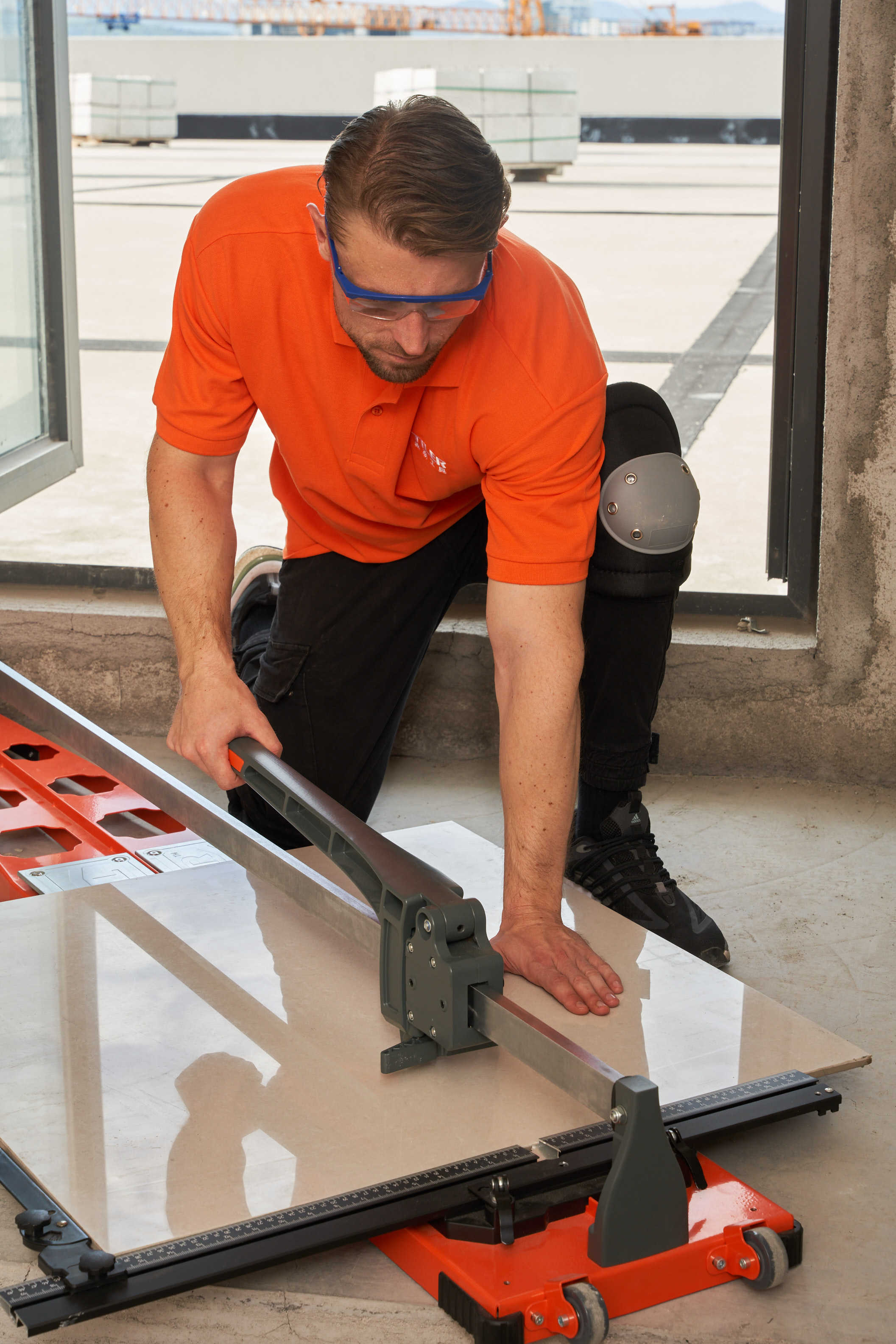
The entire TILER manual tile cutter series is engineered to handle high-hardness, high-strength tiles. With multiple base materials, multiple rail types, and multiple cutting lengths, users can choose the configuration that best fits their project requirements:
Steel Base / Reinforced Aluminum / All-Iron Frame
Three base options: steel base for maximum rigidity, reinforced aluminum for lightweight durability and portability, all-iron frame for heavy-duty applications
Single Rail / Dual Rail / Linear Rail / T-Type Track
Four rail systems: single rail for lightweight utility, dual rail for doubled precision, linear rail for smooth stable scoring, T-type track for stronger cutting force
Tungsten Carbide Wheel (Standard Across All Models)
Mohs hardness 9+ — hard enough to score through dense porcelain glaze without skidding or premature dulling
Ball Bearings + Enhanced Press Bar
Internal ball bearings ensure smooth slider movement and precise positioning; enhanced press bar delivers sufficient downward force to snap 12mm+ porcelain cleanly
Cutting Lengths from 600mm to 1,200mm+
Multiple sizes cover everything from standard tiles to large-format slabs — choose the right tool for your tile dimensions
Model Examples:
- 8102G-T3 — All-iron frame + tungsten carbide wheel + laser guide, built for heavy-duty porcelain cutting
- 8102G-2A-DJH — Reinforced aluminum base + 10 ball bearings, lightweight and portable for mobile professionals
- 8100T Series — Dual-rail design with doubled precision, ideal for high-end projects demanding perfect straight cuts
- TQT-02 — T-type track + zero-clearance bearings, stronger cutting force for thick tiles and large-format slabs
- TQX-01-1200 — 1,200mm cutting length, purpose-built for large porcelain panels and oversized tiles
Which Tile for Which Application?
Commercial Kitchen / Restaurant Floor
Low water absorption, oil-resistant, easy to clean — built to handle heavy foot traffic
Exterior Facade / Balcony / Terrace
Superior frost-thaw resistance; stands up to seasonal temperature swings and rain
Residential Bathroom Wall
Cost-effective; walls do not require high mechanical strength
High-End Living Room / Hotel Lobby
Large-format porcelain delivers superior aesthetics; pair with TILER cutting systems for precision fabrication
Standard Residential Floor
Choose based on budget and expected foot traffic — porcelain wins on long-term cost
Cost and Supply Chain Considerations
Many buyers focus solely on unit price — and miss the total cost of ownership:
One more thing: porcelain tile — especially large-format — typically has a longer supply lead time than ceramic. For large projects, confirm stock availability and delivery schedules in advance to avoid costly site delays.
Closing: Getting the Tile Right Is What Separates Professionals
Choosing the right tile is half the battle in any installation project. The ability to recommend the most suitable tile based on application, budget, climate, and installation conditions — that is what separates a trusted tile supplier from an ordinary trader.
For over 30 years, TILER has focused exclusively on the research, development, and manufacture of tile cutting and laying tools. We know this to be true:
Whether you choose ceramic or porcelain, the TILER manual tile cutter series delivers the stable, precise cutting performance your installation projects demand.
Ready to Elevate Your Next Installation?
Browse the full range of TILER manual tile cutters — engineered for professionals who demand precision, reliability, and durability on every job.